

Ends or Means
Thoughts on the national security strategy, DC holiday party dispatches, and an exclusive inside scoop on the WaPo mouse controversy.

THOUGHT: On Means and Ends
David Polansky
At the outset of the U.S. National Security Strategy, released last week, strategy is defined as a “plan that explains the essential connection between ends and means.” By all accounts, this NSS is primarily the handiwork of one Michael Anton, the outgoing Director of Policy Planning. Anton is notorious for being the author of the “Flight 93” essay, but more amusingly he previously wrote a book under the nom de plume “Nicholas Antongiavanni” titled The Suit: A Machiavellian Approach to Men’s Style—a rather severe work on men’s couture modeled after The Prince.
Machiavelli himself is, perhaps more than any other writer, associated with the maxim that the end justifies the means. And yet he never actually says this outright in any of his works. The closest he comes to such a statement is the far more graceful expression accusandolo il fatto, lo effeto lo scusi: though the deed accuses him, the effect excuses him.
The “him” in question there is Romulus, legendary founder of Rome, and the “deed” was killing his own brother, Remus—an act Machiavelli considers justified by the necessity of being alone if one wishes to found a great city. He seems to leave himself an out here—how often does one found a city like Rome? But as one reads on, it becomes increasingly clear that cities require continuous refounding.
Thus, the fundamental condition of political life is one of semi-permanent emergency in which much is permitted—from ancient assassinations to lethal strikes on “narcoterrorists” in the Caribbean. How, then, to know when to apply such extreme measures, and when a lighter touch is needed?
Machiavelli called it virtù, but perhaps a figure as sartorially obsessed as Anton would prefer…style.
David Polansky is a writer in Toronto. He writes about philosophy and politics at Strange Frequencies.

THE AFTERTHOUGHT: Pacing Threat
Nikolai Gogol
One way to understand Washington is to look at ads on the Orange/Blue/Silver line.
The soft halo of money emanating outward from the Department of War (or Defense, if you prefer) has priorities, and they find themselves reflected on the small spaces on train cars and station walls—displays for companies with names like Seekr, OneBrief, Nightwing, and ManTech (yes, ManTech). They promise to “leverage data and AI” to “enable the warfighter,” the vague taglines superimposed over maps of the Pacific Ocean, cris-crossed with arching lines symbolizing interconnectivity, or perhaps ordnance.
There have always been defense-related ads on the metro lines that run through northern Virginia. But something’s felt different in the past few years—there are more of them, and they appeal to a sense that war is changing. AI breakthroughs, record defense spending, and growing fears of China’s military seem to have all combined into a potent alchemy of corporate enthusiasm for defense modernization.
What’s not explicitly stated in those ads is that China is the US’s underlying “pacing threat,” a defense-speak justification for this immense investment.
I notice the ads on rides to my Arlington office, where I work as a defense contractor looking at China issues. I began learning Chinese after high school for arbitrary reasons. Chinese started as an interest and a skill, and later became a way to connect to a people and place halfway around the world. Eventually I moved to DC, and it became something more mundane—a career.
When I first moved to Washington, I worked in foreign policy media and research jobs and internships, and got a master’s degree, only eventually landing in DoD-land. I can’t help but notice that my career has paralleled a general movement of funding toward defense, and away from jobs for China specialists in business/consulting, diplomacy, news and media, think tanks and research, human rights advocacy, academia, and civil society. Almost like I am riding on a wavelet of money, and have slowly been circling a drain my whole career, waiting to fall through. Only the drain isn’t in the shape of a circle—it’s a pentagon.
Nikolai Gogol writes a substack on Chinese politics.

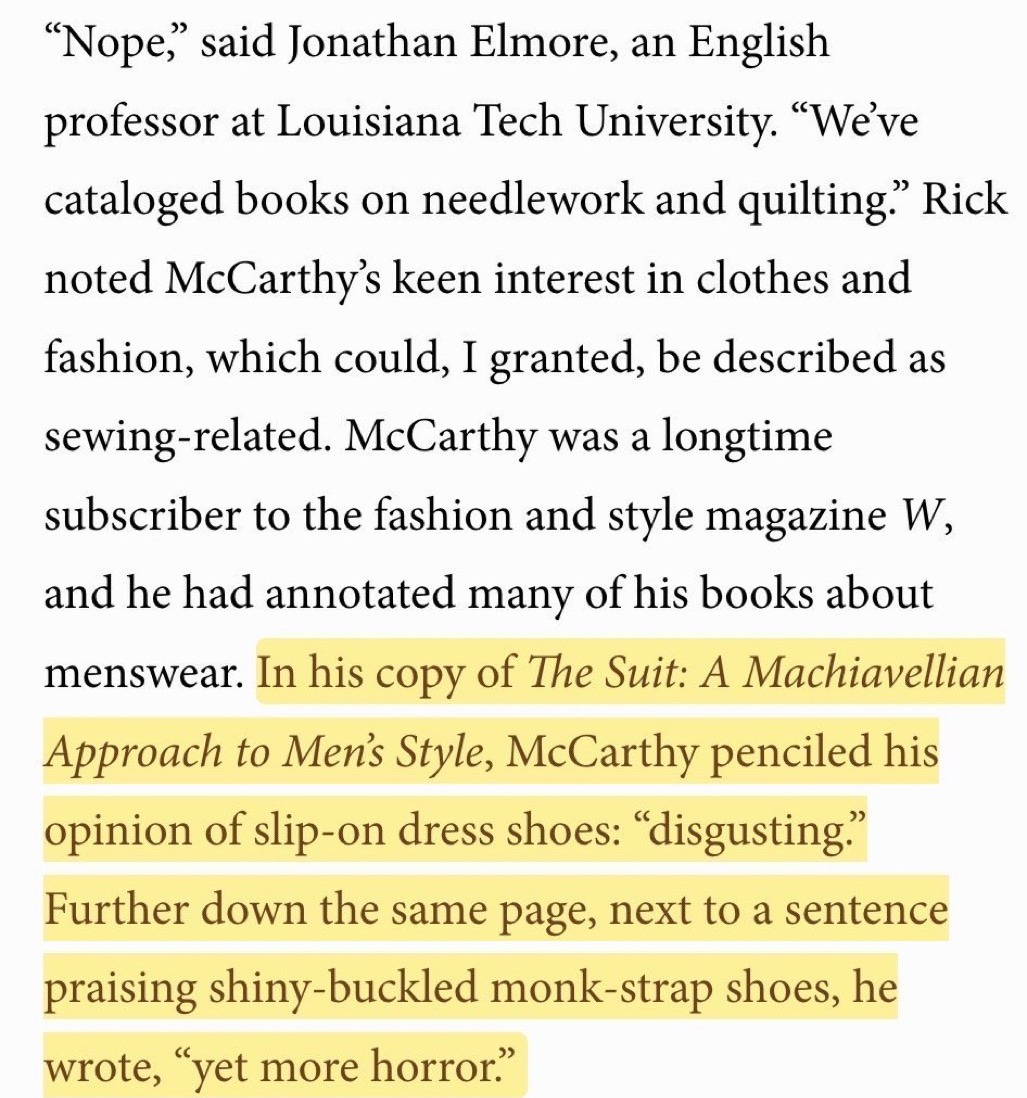
THE FIND: Cormac McCarthy’s annotated copy of The Suit: A Machiavellian Approach to Men’s Style
Recommended by Damir Marusic, H/T Sam Goldman
Much respect to Cormac the writer, even more respect to Cormac the fashionista. One wonders what else he doesn’t like about Michael Anton’s approach.
THE FEELING: Prediction Markets
Audrey Horne
I don’t consider myself a doomer, but prediction markets freak me out. Bettors place wagers on events and their probable outcomes, a logic now radically applied to everything from political elections to Taylor Swift’s dating life to the course of war. I’ve seen rationalists frame it as a “truth-seeking mechanism” (so is your heart, I tweeted) that can be deployed at a government level to help decision-makers make the best decisions possible, since truth follows money more than anything, I guess.
Defenders insist prediction markets are neutral, focused only on what will happen rather than what should happen, but I’m wary of the line between the two becoming blurred, or of creating a culture where the word “should” is not a part of our vocabulary at all. A mechanism meant to describe the future can easily begin to discipline it, subtly shifting the question from “what should we do?” to “why resist what the market already knows?” I’m suspicious of any descriptive system that could come to bear the weight of real decision making. Moral reasoning is difficult and the responsibility is heavy, and any clean shortcut that could relieve us of that burden should be met with skepticism.
Pope Francis recently warned that “recognizing and safeguarding what characterizes the human person and guarantees their balanced growth is essential for establishing an adequate framework to manage the consequences of artificial intelligence.” This warning applies with just as much force to market logic. Markets are great at aggregating belief, but they are not designed to tell us what we ought to do. Not everything that can be priced should be. The markets might tell us what we believe, but what comes around the corner when analysis loses sight of wisdom?
Audrey Horne co-edits Secret Ballot in between tweeting all day.
THE BLUFF: An Alias by Any Other Name
Guy de Forest
I started on the Hill like many other bright-eyed graduates eager to make a name for ourselves. Flocked in from across America to join the great debate — only to lose thyself and begin the slow sojourn into its heart of darkness.
The seduction began with exclusivity. Proffered a badge, evidence that you were not a mere mortal. The all powerful dot gov email. The privilege of using STAFF ONLY entrances. When you have DC’s Brightest Young Things (RIP), who needs Tatler?
It all starts with the first test. Will I follow directions without question? I was asked to do a simple task, to get some legislation signed by a man-made monster, the autopen. A contraption borne from hubris and dereliction of duty. Beware; for I am fearless, and therefore powerful.
It sat at a wooden desk previously occupied by our retired office manager. Tucked behind the marble corridors of greed and ego, its plastic housing cracked and grayed by UV light. The machine had served at least two others before its current master. I stood before it, aggrieved in my complicity.
In my mind, I heard the voice of my high school English teacher, with the Missouri twang her pastor father passed down to her. Reading to us from Miller’s The Crucible, she thundered, “How may I live without my name? I have given you my soul; leave me my name!” She paused, surveying our eyes and chiseling away with a deafening silence, freeing her angels from the marble. “All you have is your name,” she reminded us.
Before it arrived, the others told me that our office manager used to sign these writs. Her ritual, perhaps a way to clear her conscience, always used a special sharpie. It stayed locked away at her desk and knew no other words except the one name. Still, the signature came from her human hands, with her human intentions, and she had suffered, too, like the rest of us.
Was I living up to my name? Could a monster ever be held to account?
Every normal man must be tempted, at times, to spit on his hands, hoist the black flag, and begin slitting throats.
“I wonder if it’s still here,” I asked myself in quiet desperation. I pulled open the desk drawer, and there it called out to me.
Guy de Forest writes from across the river.
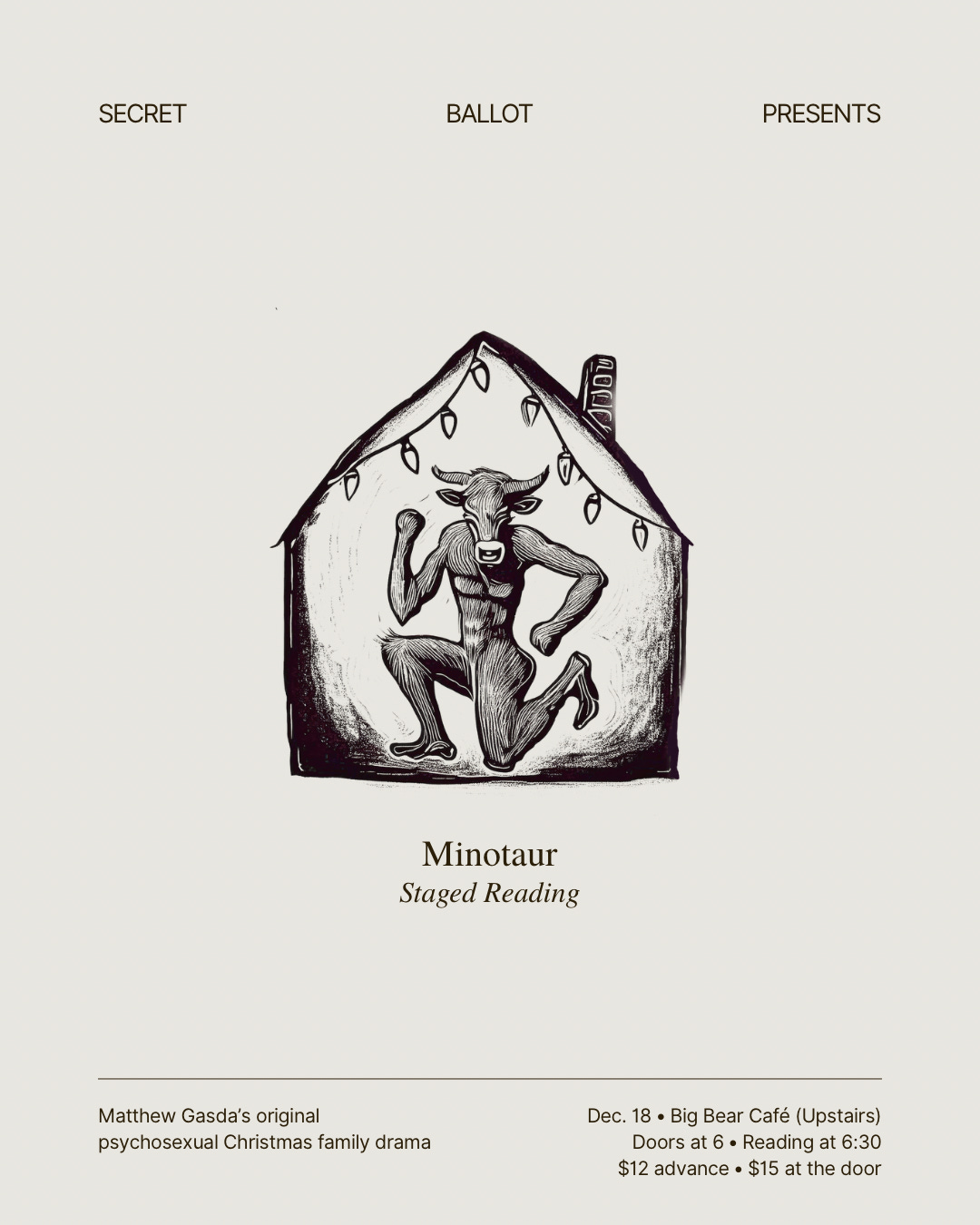
EXCLUSIVE: A few tickets are still left for the debut of Secret Ballot Presents, our dramatic reading series. We’re kicking things off with Minotaur, Matthew Gasda’s visceral Christmas drama. As the family gathers to confront impending death, the lies that held them together begin to splinter.
We’re staging a one-night reading December 18 in the lamplit attic of Big Bear Café, starring our own Sarah Beth and a cast of local conspirators. Tickets.
THE VOTE:
HOT MIC:
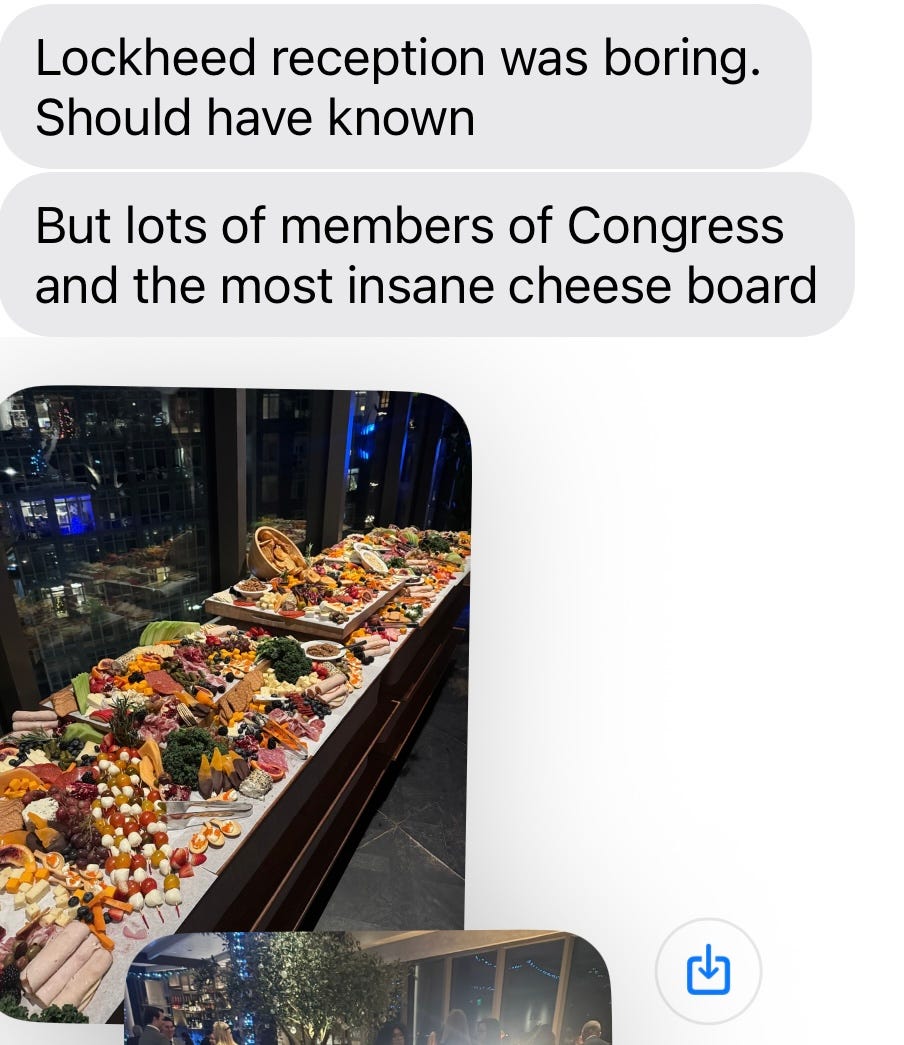

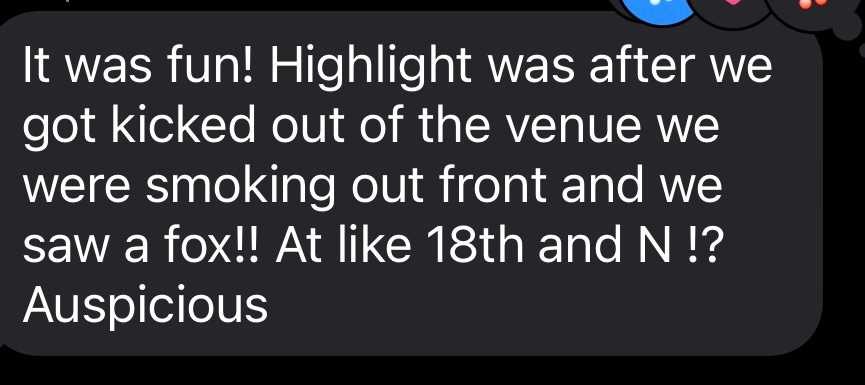
THE TALLY:
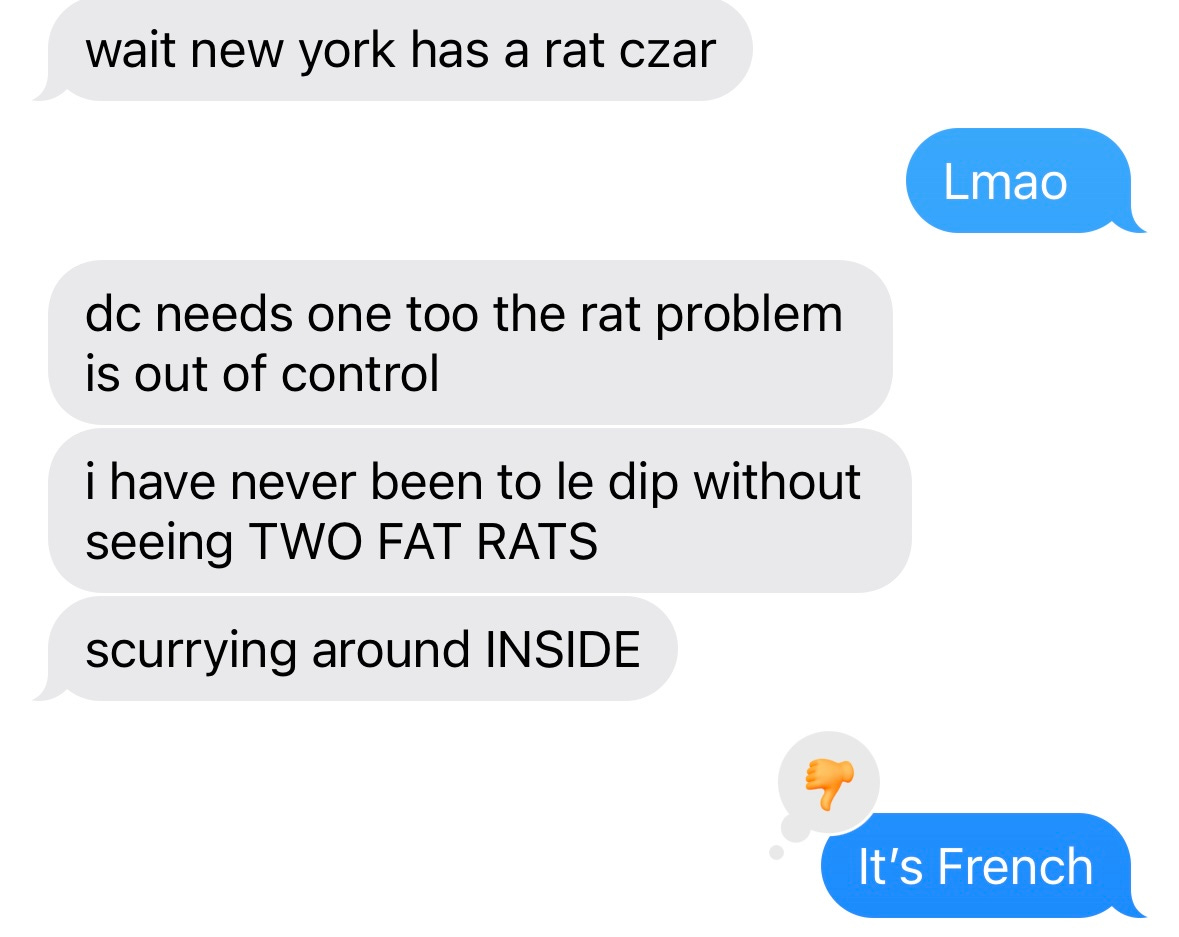
Democracy dies in darkness; mice die in newsrooms: A stray mouse was dispatched this week by an Opinions staffer in the Washington Post newsroom, an event that the News side has since inflated into an ethics symposium. Handwringing ensued. The mouse, apparently, was innocent. Secret Ballot is compelled to note that mice are vermin, not victims, and that dealing with them is neither novel nor cruel. Civilization does occasionally involve drawing lines.
