X or Y
Mathematical perspectives. Plus, this month's events roundup and a New Year's Eve report.


THE THOUGHT: Mathematical Maturity
lil stinky
My engineering job, I guess, involves an iota more math than average. I am flattering myself in saying this, though.
There is a hierarchy of purity among working mathematicians and we don’t reach their basest level.
No mathematician, however applied, would ever mistake us as one of theirs.
The most sophisticated objects we think about involve only maybe some very heuristic-driven nonparametric statistics or optimization.
We almost always have a rigid, compact linear model of our systems, of which there’s only something like 3 variations.
The most sophisticated arguments of ours, once we clean them up, are always just Cauchy-Schwarz, Fundamental Theorem of Linear Algebra and eigenvalue decomposition, all million different ways.
Don’t get too excited, all this always happens over finite dimension, with basis, with base field \mathbb{C}.
Our matrices are mostly Gram, Toeplitz, unitary, diagonal or triangular.
If you pick a really contrived problem setup then sometimes you get an uncertainty principle.
People are always name dropping the Woodbury identity but I’ve never seen it do anything useful.
Our randomness is “coin toss” or Normal, and some guys down the hall use Poisson sometimes.
No filtration zoo, everything is discrete-time.
There’s Fisher informations everywhere but since we’re in the business of always working that short list of known models, the formulas all got derived in the 60’s or earlier.
And even with such “simple” objects as I have listed it’s still easy to accidentally mess up your problem setup just so and end up with a completely analytically intractable mess that might end up wasting a lot of your time, so it’s important to make sure you just never do that. Avoid trying to ask new questions.
None of our constructions besides the barest mathematical toy models are elegant.
We are hyper-fixated on hideous objects because those are what it is our job to build.
There are enough monsters in the world that at least the quaint islands of math we can comprehend may serve as a guiding star, however wan.
Nature resists the order we try to impose on it. We must be grateful for what we can understand and fearful of what we cannot.
Sometimes a young mathematician strides in using fun language like tensor, variety, germ, Riemannian, topos, (ugh) Beamer and TikZ.
I have developed an instinctive distrust for anything written in Computer Modern.
These kids love taking up airtime using big words they think you’ve never heard.
“‘We’ve never seen a kid like this before’ they’re thinking” they think to themselves.
Importantly they give the impression of being unafraid of complexity. Maybe they have not been hurt badly enough by it yet.
Sorry, you can do all that fun stuff in your spare time but The Sponsor needs working deliverables in Powerpoint, FORTRAN and Times New Roman.
The kids will get the hang of it soon. I was like them once but my eyes are dim and my hair is gray and I am tired. I’m coming off as insecure and I am. I never had the makings of a varsity athlete.
lil stinky, a remote tech worker transplant living in gentrified brooklyn, nyc
THE FIND: Charles Minard’s Map
Ian Roos
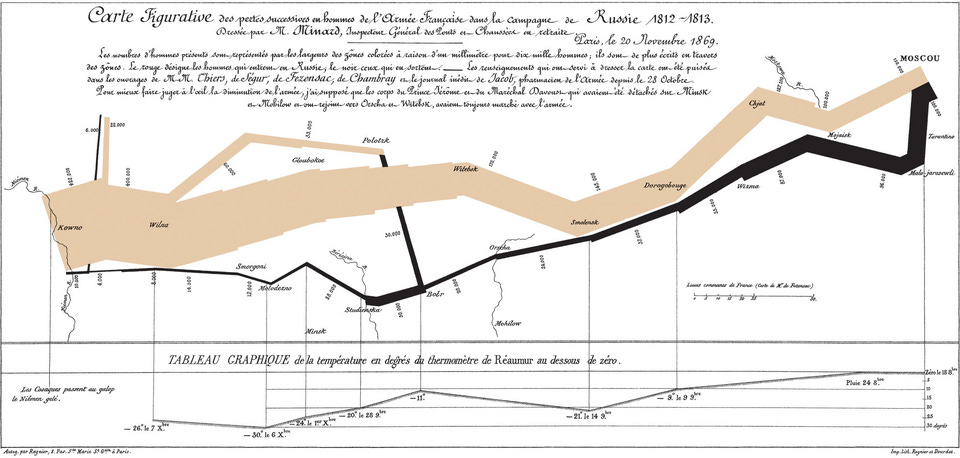
Illustrated in 1869, the French engineer Charles Joseph Minard paints a densely informative, staggeringly simple, ultimately catastrophic illustration of the failed French invasion of Russia under Napoleon.
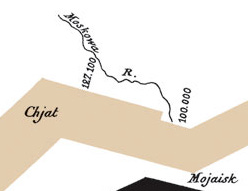
Minard elegantly draws together six distinct elements of data in a single beautiful picture that, in one gesture, illustrates the brutality and futility of war. Critics of this work point out that the Battle of Borodino is not illustrated as a location but rather a 30k reduction of men, which easily fall by the wayside in the grander scheme of the devastation that had already occurred or was yet to come. I think this instead makes a greater point to the whole. Missing information reveals a greater truth. Say less to say more.
Conversely, you might simply say more. The Battle of Borodino in Tolstoy’s words (War & Peace):
“And not for that day and hour alone were the mind and conscience darkened of this man [Napoleon] on whom the responsibility for what was happening lay more than on all the others who took part in it. Never to the end of his life could he understand goodness, beauty, or truth, or the significance of his actions which were too contrary to goodness and truth, too remote from everything human, for him ever to be able to grasp their meaning. He could not disavow his actions, belauded as they were by half the world, and so he had to repudiate truth, goodness, and all humanity.
Not only on that day, as he rode over the battlefield strewn with men killed and maimed (by his will as he believed), did he reckon as he looked at them how many Russians there were for each Frenchman and, deceiving himself, find reason for rejoicing in the calculation that there were five Russians for every Frenchman.”
Tolstoy tells the story of this invasion in approximately 470,000 words over 1,200 pages.
Charles Joseph Minard tells this story in a 63 × 25 cm infographic.
Both are correct and neither is wrong.
Ian Roos helps computers do things they shouldn’t in ways they couldn’t.
THE FEELING: Math Person
Audrey Horne.
In 2012, as a prerequisite to my degree in statistics, I took a six week summer course in set theory at the state school near my house. I’m no math genius. I struggle greatly with everything quantitative. Coding, calculus, linear algebra. None of that ever came easy. But nothing was as hard as set theory.
The course was brutal. All I had was a textbook and the Google of the early 2010s. There was no cheerful AI to help me work a problem. Instead, I would spend hours on IRC #math channels, these bare-bones, disembodied chats with (as I imagined them) ultra-nerds, who impatiently coached me through rudimentary proofs. I could sense their frustration through the screen. What came to them intuitively came to me only through psychic abrasion. “I’m so stupid,” I thought to myself.
The thing is, set theory demands a mode switch. It’s abstract. You have to prove that intangible things are true using logic. It’s like learning a language or learning to swim. For eons it feels like you’re thrashing around in the dark, grasping for a hold anywhere; sounding out words you don’t understand—or only understand in the most literal sense—in the accent and grammar of your native tongue, trying to make your right hand move forward as your left foot kicks back.
Five weeks into the course, I was dreaming in sets and barely sustaining a low C. The clock was ticking. Every day I rammed my head against the wall as half-formed proofs looped faster in my mind. If A is a subset of B. If and only if. Let x be an arbitrary element of A. For all x such that. There exists a set. By definition. The leap remained far from me.
Then it happened. I understood.
I can’t explain it. A new part of my brain unlocked, irreversibly, like the lady in Story of Your Life who learns the alien language that lets you see the future. It was as if I’d known this secret all along. There is almost nothing I’ve found as rewarding as that moment. In it I saw the bones of a complexity far greater than I could ever hope to comprehend, having suffered greatly just to glimpse the outline of a rib. I am in awe of mathematicians.
I don’t care if you’re right-brained. I don’t care if you’re “not a math person.” I don’t care. Look into it. Ram your head against the wall. Do it over and over again. Do it and it will crumble.
Audrey Horne lives in DC and edits Secret Ballot. She got an A in set theory.
THE BLUFF: ♾️
Sarah Beth Spraggins
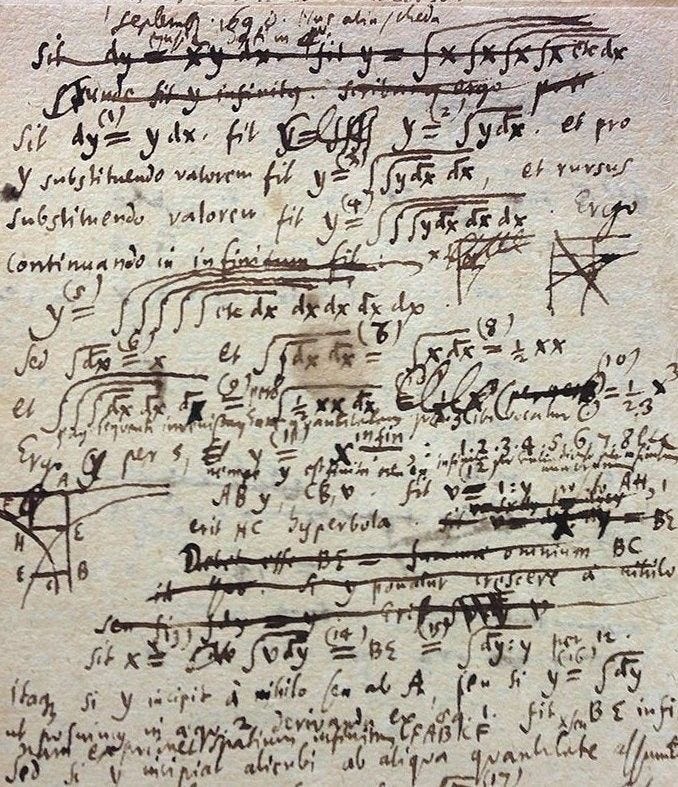
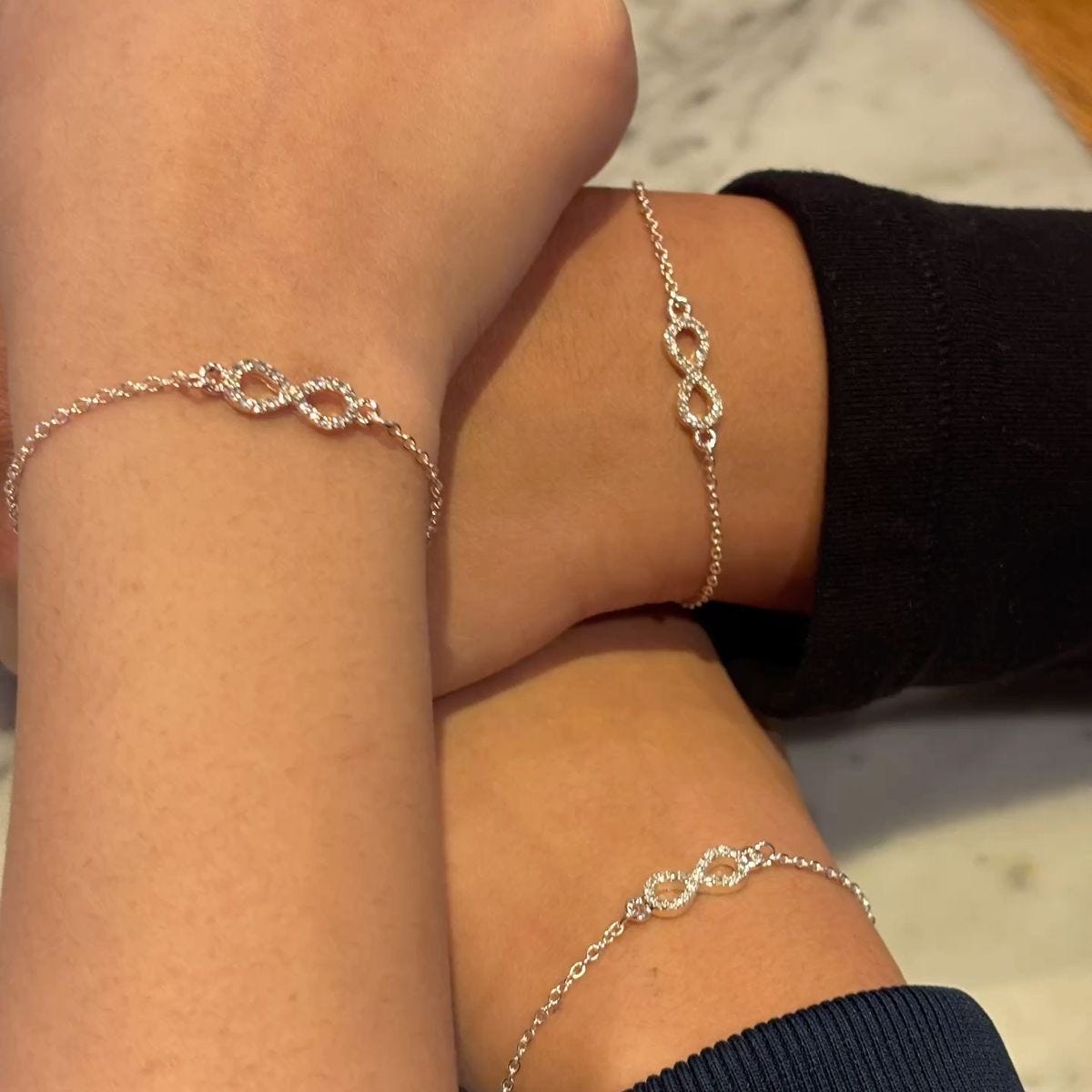
Remember when girls wore infinity signs on their sterling silver jewelry? Or got little tattoos on their wrists that looked like ♾️ but four or five times larger? In the late 2000s and early 2010s, the YA romance metaphor of choice was math or psychics related. Math was vague and sticky for little girls, like love, and therefore useful for Big Symbol. It is an oblivion like death, which can be interesting if you are 14, 24 or 54.
What is the ideal formula for 2026?
The month of January opens up a bunch of logistical, mathmatical, and philosophical questions about how to live:
Do people who are more productive than me have fewer relationships or are they more efficient about managing them and/or everything else? If I just stopped sleeping, at what point would I get sick? How many more days do I have until I need to go to the pharmacy to procure more pills? How far into this yoga pose can I get before I pull a muscle? How will I find time to get to the tailor this week? My sister’s bridal shower is this weekend— how far do I need to take in the circumference of my skirt?
Whether it’s calories or meter, a useful phrase when counting anything is “etc.” It is a gesture, like “whatever,” like ♾️, towards the great mystery. “Infinity scared me / when I was small,” wrote Molly Brodak.
Math involves solvable problems, binaries and units like these, but eventually the top comes off of math too. Life is made up of formulas ➕
Sarah Beth got away with never taking a calculus class, not even pre-calc.