
Stage or Screen
Performances! Plus exclusive tickets to a "forbidden topics" event for Secret Ballot readers below the paywall


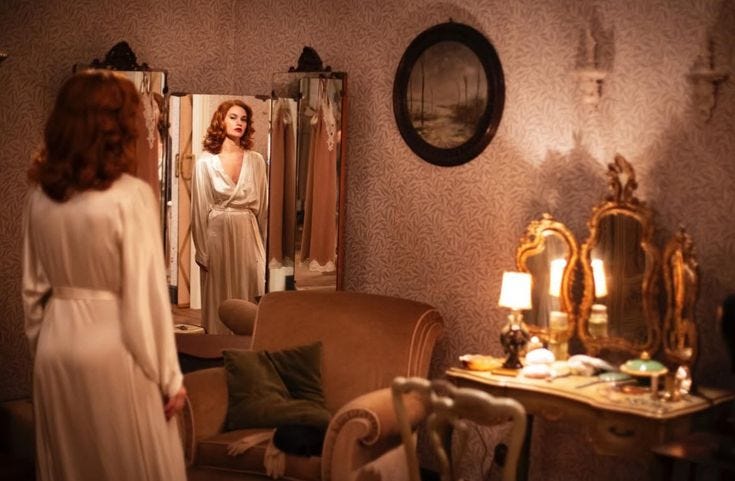
THE THOUGHT: Moulin Rouge!
Susannah Black Roberts
Baz Luhrmann. Baz Luhrmann! Who would we be without him? Nobody, that’s who. We would be here in the first year of the second quarter of the twenty first century as absolute orphans, cut off from that most crucial source of American selfhood.
I am speaking of course of the movie musical.
When Moulin Rouge! dropped in 2001, as far as anyone knew the great age of movie musicals was over. We (that is, all the homeschooled kids in Oregon, plus me, on the Upper West Side of Manhattan) would watch (over and over again) The Sound of Music and My Fair Lady and Oliver! and The Music Man and so on. But our less weird peers were simply puzzled by the concept: Why is Maurice Chevalier bursting into song in the middle of the Champs Elysees? What is even going on?
Sure, we’d had Newsies (my beloved Newsies) in 1992, The Fantasticks in 1995, and Evita in 1996 (Madonna was not as good as Patti Lupone.) Crucially, we’d had the bizarre and wonderful Alicia Silverstone/Kenneth Branagh Love’s Labour’s Lost in 2000, a jukebox musical made up of the sorts of songs I knew best: Cole Porter, Jerome Kern, the Gershwins. But Love’s Labour’s Lost was not what one might call box office gold, and other than those, and a couple of other films even I’ve never heard of, all we had in the way of musicals was The Lion King. A Little Mermaid. Beauty and the Beast. And so on. And it seemed that there was no reason that things should not go on that way: An animated teapot voiced by Angela Landsbury stomping on a human face forever.
And then Moulin Rouge! Luhrmann obviously took inspiration from Love’s Labours Lost, but thought that perhaps going with period music was not putting his best foot forward. (That was a can-can reference). And he clearly (to me, because he is my spirit animal and my brother) was on a mission: to explain to his young Gen X/elder Millennial audience what musicals were, and why they should love them.
He did this by, as far as I can tell, picking up every ingredient he had ever loved in this tradition, shoving it into a blender, turning it on puree, and decanting the result onto film. You’ve got La Boheme, you’ve got Gilbert and Sullivan, you’ve got the Folies Bergère, you’ve got American vaudeville, you’ve got the whole Broadway musical comedy tradition. You’ve got Busby Berkeley. You’ve got the original Jose Ferrer film about the painter Henri de Toulouse-Lautrec (which my father had shown me when I was about seven: we had a big Toulouse-Lautrec coffee table book that I loved looking through.)
And then you have the most insane blend of contemporary-to-2001 pop songs ever assembled to make a libretto. “Nature Boy” (what) performed by John Leguizamo (I beg your pardon) as Toulouse-Lautrec (I’m just imagining the pitch meeting for this.) Fatboy Slim’s “Because We Can” sung by Jim Broadbent (I might have recognized him from Time Bandits) as the impresario Harold Zidler. A mashup of “Diamonds are a Girl’s Best Friend” and “Material Girl” sung by Nicole Kidman as the music hall courtesan Satine along with Broadbent and a couple of chorines. Elton John’s “Your Song,” performed by Ewan McGregor as Christian, Satine’s lover.
Because, again, I had the musical upbringing of a homeschooler, when I first saw the film, it was the first time I had ever heard most of these songs. I knew David Bowie because of Labyrinth. (Labyrinth!) I was familiar with the Carol Channing version of “Diamond’s Are a Girl’s Best Friend.” I had never heard of Elton John, or Phil Collins, or Sting, though I can remember my father trying to convince me that Roxanne was a reference to Cyrano de Bergerac. (There had been a 1973 Broadway musical version of Edmond Rostand’s play with a score by Michael J. Lewis and book/lyrics by, bizarrely, Anthony Burgess. Christopher Plummer starred as Cyrano, who got a Tony for it. Christopher Plummer as Captain Von Trapp was, of course, my first love, right before David Bowie in Labyrith.)
Baz Lurhmann’s absinthe fantasy of a jukebox musical did not perhaps succeed in reviving the musical genre for the twenty-first century to the degree that he would have liked. We haven’t yet had a spate of films by contemporary equivalents of Lerner and Loewe, or Rodgers and Hammerstein. But it did a very strange and intricate job of linking Broadway and film and pop and rock in a way that seems like it is only beginning to pay off. It did something. It struck, as you might say, a chord.
It’s on Broadway now. My husband took me (it was not his idea) to see it for our fourth anniversary. About half of the songs were the same as those in the film; the other half were more recent, contemporary to its present-day audience.
Periodically throughout the night, the guy to my right - geriatric millennial, maybe mid-millennial - would start singing along, softly. I was initially extremely irritated by this. Doesn’t he KNOW that that is not DONE in the THEATER? The THEATRE, even? Does he think he’s in his CAR?
At the end, though, the performers invited the whole audience to do the same. And I realized that I had missed the point. The man to my right singing along, softly, to Lorde’s “Royals” in the first act might not have been the standard Broadway audience member. He’d probably gotten tickets to the show because when he was a young teen he’d see the movie. And that was the point. That was the whole point. And I realized that in fact, Baz Luhrmann - Baz, you mad genius! you glorious impresario! you legend! - had been ahead of me the whole time.
And the century is young.
Susannah Black Roberts is a senior editor at Plough. She writes at Radio Free Thulcandra and The Anchored Argosy.
THE FEELING: Melpomene
Audrey Horne
My friend Suzy recently took me to see Death of a Salesman on Broadway. I had never seen the play or the movie, or read it, and I knew nothing about it other than the fact that it was written by Marilyn Monroe’s ex-husband. I thought of those gauzy photos of Marilyn holding a bunch of daisies and that nerd Arthur Miller staring at her. I knew just from those photos that he treated her badly.
I was really in no state to be watching a tragedy. If I had known what it was, I might have refused. I’m very sensitive. People think I’m not, but I am. As it happened, I was held captive — completely by surprise — to three hours of unrelenting grief. Nobody told me it was going to be like this. It felt like a monster was cracking open my sternum with a saw and holding it open with a clamp and sticking his claws into my chest cavity and slicing my heart into ragged little chunks of red meat.
God uses art to remove the scales from our eyes. He can show us the full light of reality for a split second, if He chooses to. The pathetic lies we tell ourselves to get by. The ways we try to hold onto dignity. To make things good for others and for ourselves. The way we think we know what dignity means. That poor man. God. I was sobbing and clutching my knees in the end. “I understand.” I told Suzy. “That’s my life.”
Audrey Horne edits Secret Ballot.
THE FIND: Taffety Punk
Recommended by Josef Palermo
I’m a huge fan of Taffety Punk theatre company in DC—they do real cool shit and never charge more than $20 for tickets to their performances.
Their last show was in February — a retelling of Beowulf set in a bar. We reached out to ask what their next performance will be, but haven’t heard back yet… stay tuned. In the meantime, go see Othello at the STC.
Josef Palermo is an artist and arts organizer in Washington, DC.
